
10 SEO APIs for 2026: Five You Know, Five You Don't
 Thomas Mann
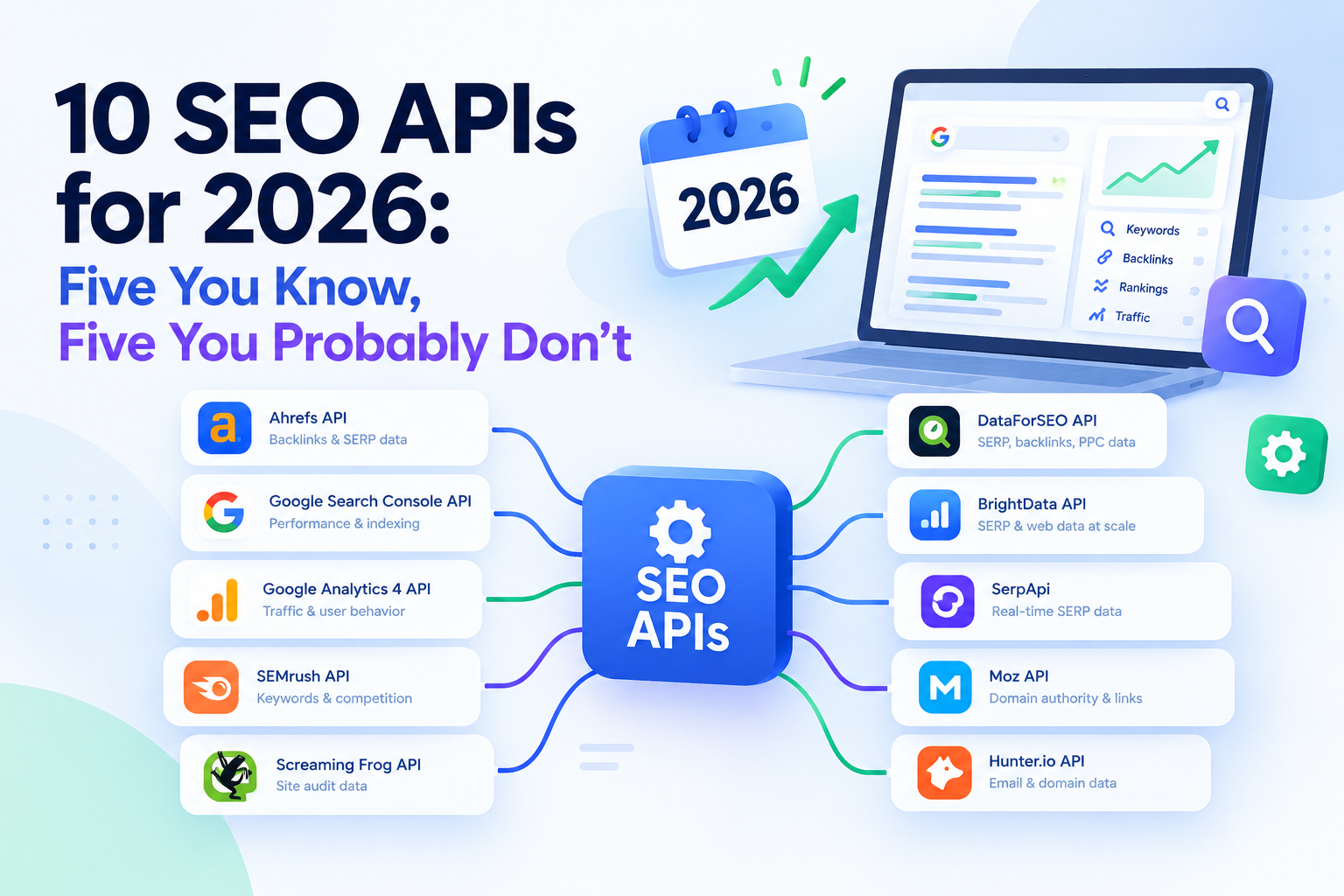
10 SEO APIs for 2026: Five You Know, Five You Probably Don't
Every "best SEO API" list covers the same five or six providers, quotes their pricing pages, and picks a winner. Usually the winner is whoever sponsored the article.
This one is organized differently, because the market split in two. Classic SEO APIs answer one question: where do I rank in Google? A newer layer, most of it built since 2025, answers two questions the old layer can't touch — do AI systems mention me, and which AI crawlers are actually reading my site?
Below: five workhorses worth knowing, five newer APIs that rarely make these lists, and an honest look at why comparing their prices is harder than any pricing page admits. All figures were checked against official documentation, not copied from other roundups — which, as you'll see near the end, turns out to matter.
How We Compared Them
Seven criteria, chosen because they're what actually decides the buy:
- Data coverage — SERPs, backlinks, keywords, on-page, AI Overviews, crawler logs
- Pricing transparency — can you predict next month's bill before you write the integration?
- Rate limits and scale — requests per minute, concurrency, batch support
- AI search coverage — can it see AI Overviews, ChatGPT, Perplexity, Gemini?
- Developer experience — docs, SDKs, error semantics, sandbox
- Real free tier — an actual ongoing allowance, not a 7-day trial
- Integration surface — MCP, n8n, Make, Looker Studio, webhooks
One caveat before the numbers: API pricing changes faster than articles get updated, including this one. Treat every figure here as a starting point for your own check against the provider's docs.
The Billing Problem: Six Pricing Models Pretending to Be One
Here's the thing nobody says plainly. Every provider sells roughly the same data. What differs is how they charge, and the units are not comparable.
| Unit sold | Who uses it | What it actually means for your bill |
|---|---|---|
| Successful searches | SerpAPI | One query = one unit. Easiest to forecast, priciest per query |
| Tasks / requests | DataForSEO, Bright Data | Priced per SERP page, often by latency queue — you pay more for speed |
| API units | Ahrefs, Semrush | Cost depends on rows and which fields you select. Same query, wildly different price |
| Rows | Moz | Simple, but a "row" means something different at every provider |
| Credits | SE Ranking, Serpstat, Firecrawl | One credit buys different things on different endpoints. Read the conversion table |
| Tracked prompts | Profound, Peec AI | You pay per monitored question, per model. Adding engines multiplies cost |
| Quota | Google Search Console | Free, capped by requests per minute rather than money |
This is why "$0.0006 per request" and "50 units per request" can't be compared without doing your own math on your own workload. A DataForSEO SERP call and an Ahrefs unit are not the same product, and any table claiming otherwise — including the one below — is an approximation.
Master Comparison
| Provider | What it gives you | Model | Entry cost | Free tier |
|---|---|---|---|---|
| DataForSEO | SERPs, keywords, backlinks, on-page, AIO parsing | Pay as you go | ~$0.60 per 1,000 standard SERPs | $1 trial credit |
| SerpAPI | Real-time SERPs, 100+ engines, AIO and AI Mode | Monthly searches | $25/mo for 1,000 searches | 250 searches/mo |
| Ahrefs API v3 | Backlinks, keywords, SERP overview, Brand Radar | Subscription + units | From the Lite plan (~$129/mo) | Free DR endpoint, free Rank Tracker endpoints |
| Bright Data | SERP scraping at enterprise scale | Per 1,000 results | $1.50/1K, down to $1.00/1K at volume | Trial available |
| Google Search Console API | Your own queries, clicks, impressions, positions | Free quota | $0 | Entirely free, 1,200 QPM per site |
| Profound | Brand visibility across AI answer engines | Tracked prompts | $99/mo starter, $499/mo self-serve Lite | None |
| Peec AI | Same category, European, cheaper entry | Tracked prompts + models | $95/mo for 50 prompts | None |
| Exa | Neural/semantic web search for agents and RAG | Per search + compute | ~$7 per 1,000 searches | $20 signup + $10/mo credits |
| Firecrawl | Search + scrape + crawl, LLM-ready output | Credits | $3.20/1K credits down to $0.60/1K at scale | 1,000 credits/mo |
| Cloudflare AI Crawl Control | Which AI crawlers hit your site, and what they send back | Included | $0 | Available on all plans, including free |
Part One: The Five Workhorses
1. DataForSEO — The Cheapest Way to Run Volume
DataForSEO is the raw data layer a surprising number of other tools quietly sit on. It handles proxies, parsers, and anti-bot work, and sells the output by the request.
Pricing is pay as you go with no subscription: roughly $0.0006 per standard SERP request, or about $0.60 per thousand. Live requests cost more, around $0.002 each, because you're paying for latency — there are three priority queues, and the cheap one takes about five minutes. There's a $50 minimum deposit and $1 of trial credit on signup. Rate limits go up to about 2,000 requests per minute, which is more than most projects will ever need.
What you don't get is an interface. There is no dashboard to show a client, no visual anything. That's the trade, and for a developer building a rank tracker or a research pipeline it's the right one.
Best for: anyone running high-volume queries where cost per request is the deciding factor.
2. SerpAPI — Real-Time Fidelity, at a Price
Where DataForSEO optimizes for cost, SerpAPI optimizes for accuracy and breadth. Over 100 search engines, clean structured JSON, automatic parsing of featured snippets, Knowledge Graph and People Also Ask, plus dedicated AI Overview and AI Mode endpoints.
Plans start at $25/month for 1,000 searches and scale to $275/month for 30,000. Normalized, that's somewhere between $9 and $75 per thousand searches depending on tier — an order of magnitude above DataForSEO. There's a genuine free tier of 250 searches a month, which is enough to prototype.
You're paying for reliability and developer experience rather than data you can't get elsewhere. For a customer-facing feature that must return a live, correct SERP on demand, that premium is usually justified. For bulk research, it isn't.
Best for: real-time rank verification, multi-engine research, anything user-facing.
3. Ahrefs API v3 — Link Intelligence, Priced by the Column
Ahrefs remains the reference point for backlink data, and v3 is the current version — v2 was fully discontinued on 1 November 2025, so any tutorial you find referencing it is dead code.
The pricing model deserves attention because it's unusual. Cost is max(50, per_row_cost × rows): a base of 50 units per request, and a per-row cost that's the sum of every field you touch. Most fields cost 1 unit, but a few cost 5 or 10. Selecting two extra columns can quadruple the price of an otherwise identical query. Monthly quotas run roughly 25,000 units on Lite, 150,000 on Standard, 500,000 on Advanced, and 2,000,000 on Enterprise.
Two things most roundups miss. Ahrefs publishes a free Domain Rating endpoint that needs no subscription at all, which makes it viable as a cheap pre-filter in front of paid calls. And the Rank Tracker endpoints consume no units whatsoever — if you only need your own tracked positions, you never touch your quota.
Best for: backlink analysis, competitor link research, and SERP-level metrics you can't get from a scraper.
4. Bright Data SERP API — When the Constraint Is Infrastructure
Bright Data is less an SEO tool than a scraping infrastructure company that happens to sell a SERP product. Its argument is a proxy network north of 150 million IPs and an independently measured success rate above 98%.
Pricing starts at $1.50 per 1,000 requests with no commitment, dropping to about $1.30/1K on the $499/month Growth plan and $1.00/1K at the $1,999/month enterprise tier. You pay only for successful requests, which matters more than it sounds when you're running millions of them.
The cost is complexity. Pricing is layered, the learning curve is real, and it's overkill unless your volume genuinely justifies it.
Best for: millions of queries, compliance-sensitive industries, feeding data lakes.
5. Google Search Console API — The Free One Everyone Forgets
It appears in almost no "best SEO API" list, for an obvious reason: nobody earns commission recommending it.
The Search Analytics endpoint gives you queries, clicks, impressions, CTR and average position for your own properties, free, at up to 1,200 queries per minute per site. That's first-party data no paid provider has — they estimate what GSC measures directly.
The limits are equally clear. It only covers sites you own, and the interface caps history at 16 months, which is why teams set up bulk export to BigQuery to keep their own longer archive.
Best for: the baseline layer of literally any SEO pipeline. Build here first, then buy what's missing.
Part Two: The Five That Rarely Make These Lists
Everything above answers "where do I rank in Google". The next five exist because that question stopped being the whole picture.
6. Profound — AI Visibility, With Real Money Behind It
Profound tracks whether AI answer engines mention your brand. It combines synthetic queries with monitoring of live AI responses across ChatGPT, Claude, Google's AI surfaces and Perplexity.
The category's seriousness is easy to gauge from funding: Profound raised a $96M Series C in February 2026 at a $1B valuation, led by Lightspeed with Sequoia and Kleiner Perkins participating. That's not a niche tool anymore.
Pricing starts around $99/month, but read the fine print — the starter tier tracks ChatGPT only, and most buyers want Perplexity and AI Overviews too, which pushes them to Growth at $399/month or self-serve Lite at $499/month. Enterprise contracts reportedly land between $30,000 and $100,000+ a year.
Best for: brands where being cited by an AI assistant is now a board-level metric.
7. Peec AI — The Cheaper European Entry Point
Founded in 2025, Peec AI raised a €21M Series A after a €5.2M seed, and competes in the same category from a lower price point.
Self-serve plans start at $95/month for 50 tracked prompts, $245 for 150, and $495 for 350. The detail worth knowing before you budget: base plans include three AI models chosen from a six-engine pool, and extra models are add-ons at $30, $70 or $140 depending on tier. Your real cost is prompts multiplied by engines, not the headline number.
Best for: teams that want AI visibility tracking without an enterprise contract.
8. Exa — Search That Understands Meaning
Exa isn't an SEO tool at all, which is exactly why it's interesting. It's a neural search API trained on link prediction, so it retrieves pages that are conceptually related to a query, a URL, or a topic — even when none of the keywords match.
That's a different job from SERP scraping. It's how you find "pages like this one" across the web, build a topical map without a keyword list, or feed a RAG pipeline with relevant sources rather than keyword hits.
Search runs about $7 per 1,000 requests returning up to 10 results, with $20 in signup credits and $10 in credits every month after. The Agent API, launched in June 2026, prices differently again: $0.10 per compute unit, $0.005 per search call, and fixed effort modes from $0.012 to $1.00 per request.
Best for: topical research, content gap discovery by meaning rather than keyword, and any agent that needs to actually understand what it found.
9. Firecrawl — The Full Web Data Stack
Firecrawl bundles search, scrape, crawl and structured extraction behind one API, with output formatted for LLM consumption rather than for a browser. Over a million developers and 130K+ GitHub stars suggest it solved a real problem.
For SEO work, the useful part is what it does after the SERP. Pull the top ten results, then crawl and structure each one — headings, schema, word counts, pricing tables — in the same pipeline. That's competitor content analysis at scale without maintaining your own scraper.
Pricing is credit-based: 1,000 free credits a month, search costs 2 credits per 10 results, and credits run from about $3.20 per thousand on the entry plan down to $0.60 per thousand at scale on annual billing. Watch the extraction endpoints — they consume credits far faster than search does.
Best for: competitor page analysis, content audits, and any workflow where the SERP is just step one.
10. Cloudflare AI Crawl Control — The Data Nobody Else Has
This one is genuinely unique, and it's free.
Every other API on this list tells you about search results. Cloudflare AI Crawl Control (formerly AI Audit) tells you about your own logs, from the other direction: which AI crawlers are hitting your site, how often, which paths they favour, whether they respect your robots.txt, and how much referral traffic each one sends back.
Cloudflare sees roughly 20% of internet traffic and fingerprints more AI bots than anyone else, which is why this data is hard to reproduce yourself. February 2026 added path pattern grouping and referral analytics by operator. There's a GraphQL API for crawler requests, top paths, referral traffic and data transfer, with filtering by user agent and referrer domain. Pay per crawl — charging AI companies for access — is in private beta.
The best part: it's available on all Cloudflare plans, including the free one. If your site is already behind Cloudflare, you have this data right now and probably haven't looked at it.
Best for: understanding whether AI systems can even read your content before you worry about whether they cite it.
The MCP Layer: A Different Way to Consume All of This
By mid-2026 there are more than 60 SEO-specific MCP servers. Ahrefs, Semrush, SE Ranking, DataForSEO and Advanced Web Ranking all ship official remote endpoints.
The shift is in how you consume the data. Instead of writing an integration, you connect a server to an AI assistant and ask in plain language — pull these keyword volumes, check this domain's backlinks, run this audit. For exploratory work and one-off analysis, it removes a genuine amount of friction.
Two honest caveats. Most of these servers are read-only, so they inform decisions rather than execute them. And an MCP server is not a replacement for a pipeline: it's excellent for asking questions, and the wrong tool for running the same job reliably every morning at 6am.
AI Search Monitoring vs LLM Monitoring — Not the Same Thing
This distinction gets blurred constantly in vendor marketing, and buying the wrong one is an expensive mistake.
AI search monitoring tracks what a user actually sees in an AI search product — the answer, and critically the citations and links in it. That's the thing that can send you traffic.
LLM monitoring probes the model's own trained knowledge by asking it questions. It returns no citation data, because there are no citations. It tells you what the model absorbed during training, which is interesting for brand perception and useless for traffic attribution.
Before signing anything in this category, ask which one you're being sold. If the answer includes citation and link data, it's the first. If it's "we asked ChatGPT about your brand 500 times", it's the second.
The Free Tier Nobody Lists
A meaningful share of SEO data costs nothing, and paid roundups have no incentive to mention it:
- Google Search Console API — your own search performance, free, 1,200 QPM
- Bing Webmaster Tools API — the same idea for Bing, which now matters more as a Copilot data source
- Google Business Profile Performance API — location-level search and discovery metrics
- Ahrefs free Domain Rating endpoint — no subscription required, ideal as a bulk pre-filter
- Ahrefs Rank Tracker endpoints — consume zero API units on a paid plan
- CrUX and PageSpeed Insights APIs — real-user Core Web Vitals, free
- IndexNow — push URL changes to participating engines, free
- Cloudflare AI Crawl Control — AI crawler analytics on every plan
Build the free layer first. A lot of projects discover they only needed one paid provider, not four.
Which One for Which Job
| The job | Start with | Why |
|---|---|---|
| Rank tracking at volume | DataForSEO | Cost per request decides everything at scale |
| Live rank checks in a product | SerpAPI | Reliability and parsing quality beat price here |
| Backlink and competitor analysis | Ahrefs | Nobody else has the index; watch your column selection |
| AI visibility and citations | Peec AI, then Profound | Start cheap, scale up if the metric proves itself |
| Semantic research and RAG | Exa | Keyword matching is the wrong tool for this job |
| Competitor content at scale | Firecrawl | Search and structured extraction in one pipeline |
| Who is crawling you | Cloudflare AI Crawl Control | Free, and no SEO provider has this data |
| Your own site's performance | Google Search Console API | Measured, not estimated, and free |
What These Listicles Get Wrong
Three failure modes worth knowing, including in this article.
Prices go stale immediately. Every provider here has changed pricing in the last eighteen months. An article published in May is describing a market that no longer exists by September.
Most roundups are sponsored. The tell is a clear winner named in the first paragraph and again in the FAQ. That doesn't make the information wrong, but it does explain the ordering.
They copy each other rather than checking sources. Here's a concrete example. A widely-shared 2026 roundup states that Ahrefs API access requires the Enterprise plan at $1,499/month. Ahrefs' own documentation says the API is available on eligible paid plans, and independent testing puts practical access at the Lite tier around $129/month. That's a ten-fold difference in a buying decision, repeated because nobody opened the docs.
The practical defence: before you commit, open the provider's pricing and limits pages yourself, and price one real request against your actual workload. Most providers offer a free test query for exactly this.
Honorable Mentions
- Semrush — strongest if your team already lives in the suite; API costs are hard to normalize
- SE Ranking — platform plus AI Search API, with a native MCP server
- Serpstat — budget keyword and competitor data, and credits that roll over
- Moz — cheapest route to domain authority metrics
- Majestic — a 19-year historical link index and Trust Flow, unmatched for domain history checks
- Authoritas — expands AI Overviews programmatically to capture the citations inside them
- Otterly and Scrunch — further options in the AI visibility category
- Tavily and Brave Search API — lightweight search for agents; Brave runs an independent index
Conclusion
There is no best SEO API, and any list that names one is answering a question you didn't ask.
What's changed in 2026 is that the stack has two halves. The classic providers still answer where you rank, and they've become genuinely commoditized — the choice between them is mostly a billing decision. The newer layer answers whether AI systems see you, cite you, and can even read your pages, and those questions had no vendors at all two years ago.
The sensible sequence: start with the free first-party data, add one paid provider for the specific gap you can name, and only then look at the AI visibility layer — once you can articulate what you'd do differently based on what it tells you.
Further Reading (Sources & Documentation)
Official documentation and pricing
- Ahrefs API — limits and unit consumption
- Ahrefs API — pricing
- Cloudflare AI Crawl Control — documentation
- Google Search Console API
- Firecrawl — web search API comparison
Pricing analysis and comparisons
- Thunderbit — 9 Best SEO APIs with real cost-per-request data
- fastCRW — Web Search API pricing compared (2026)
- fastCRW — Firecrawl pricing explained
- Acromatico — AI visibility tool pricing compared
- SitePoint — Top 10 SEO Data APIs for 2026
AI visibility and MCP
- Backlinko — AI visibility tools to track your brand across LLMs
- Nightwatch — Best SEO MCP servers, tested
- Cloudflare — Introducing AI Crawl Control
