
How to Automate Expired Domain Buying with Ahrefs
 Thomas Mann
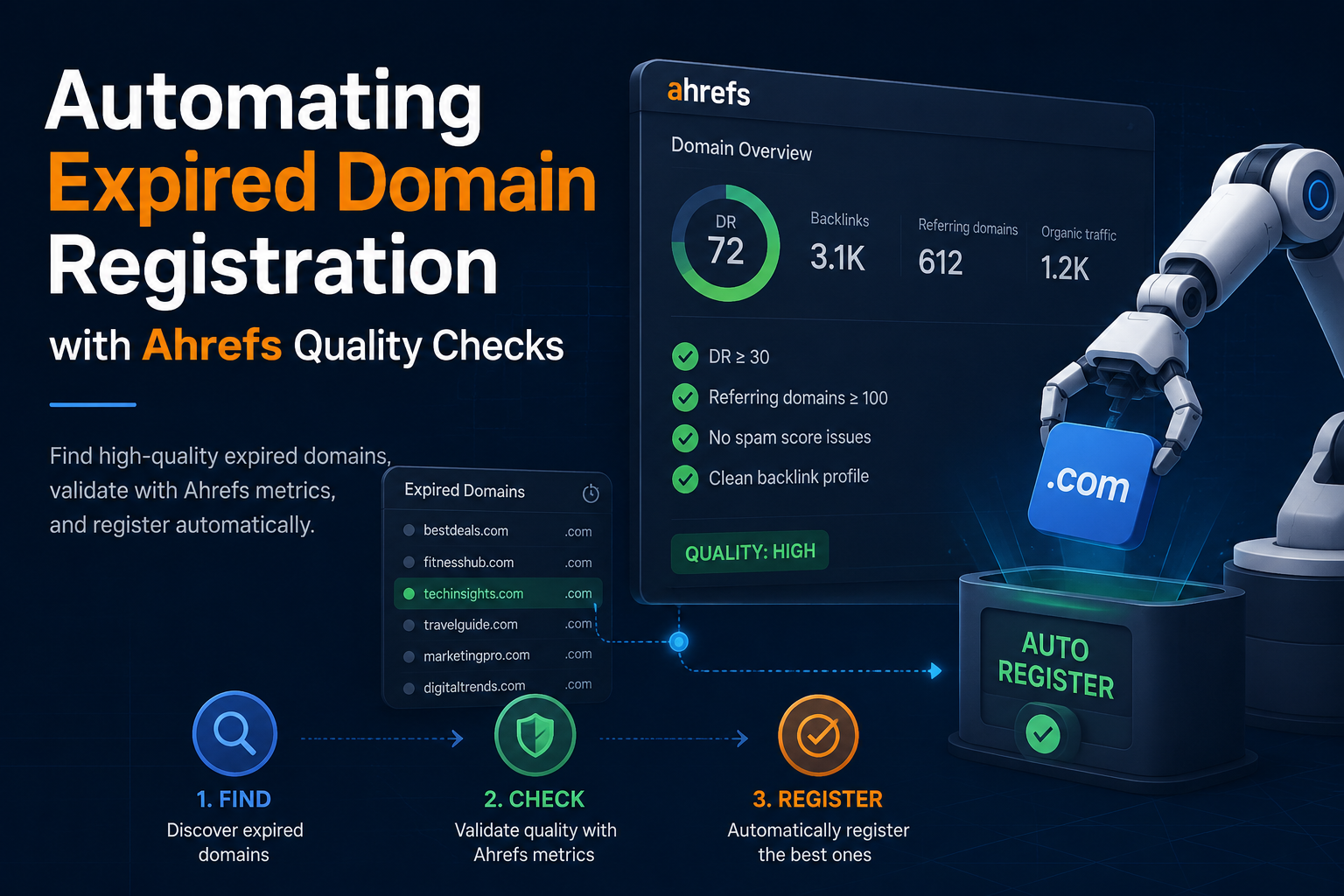
Automating Expired Domain Registration with Ahrefs Quality Checks
Every single day, thousands of registered domains expire and quietly become available again. Most of them are worthless. A small number still carry real value — established backlinks, brand history, even leftover traffic. The problem is telling the two apart fast enough to matter.
This article explains how that process gets automated: where the domain lists come from, how Ahrefs is used to judge quality, and which registrar APIs actually handle the buying. The first half is written for anyone. The sections marked [Technical] go deeper into specific APIs and limits — skip them if you're not the one building it.
Why Anyone Bothers With Expired Domains
An expired domain isn't just an empty address. If the previous owner ran a real site there, other websites may still be linking to it. Search engines may still recognize it. That accumulated history is what buyers are after.
Think of it like a storefront in a good location going vacant. The address already gets foot traffic. The building already has a reputation. You just need to spot it before someone else signs the lease.
The catch is that most expiring domains have no value at all. Many are actively harmful — former spam sites, link farms, or domains with a history that will never rank again. And the genuinely good ones disappear within seconds of becoming available. That combination is exactly why this gets automated.
Why Manual Hunting Doesn't Work
Three separate problems make manual searching hopeless.
Volume. Hundreds of thousands of domains sit in the deletion queue at any given time. DropCatch alone tracks roughly 600,000 pending deletion. No one reviews that by hand.
Speed. Valuable domains are caught within seconds of release. The services doing the catching run over a thousand registrar accreditations specifically to win that race. If you're typing a name into a search box, you've already lost.
Judgement. Even if you could see every domain, you couldn't manually assess whether each one has a clean backlink profile. That's a data question, not a browsing question.
Put together, this is a filtering problem. Filtering at volume is exactly what automation is good at.
What the Automation Actually Does
Stripped down, the whole system does three things:
Collect. Pull the daily list of expiring and dropping domains from a data source.
Judge. Check each domain's quality metrics automatically. This is where Ahrefs comes in.
Act. Register or place a backorder on the ones that pass, automatically, through a registrar's API.
It works like a recruiter screening five hundred CVs overnight against fixed criteria. The machine doesn't make the hire. It just makes sure a human only ever looks at the twelve worth interviewing.
Where the Domain Lists Come From
The raw source is registry drop lists — domains officially scheduled for deletion. These are public, but messy to work with directly.
Most people use aggregators instead. ExpiredDomains.net, DomCop, and SpamZilla all publish pre-filtered lists, some with export or API access. They save you the work of assembling the raw feed yourself.
Auction platforms are a parallel source. GoDaddy Auctions, DropCatch, SnapNames and NameJet (which have shared inventory since 2020), Dynadot, and Sedo all sell expiring domains before they fully drop. Auction domains cost more, but the competition is visible and the process is less of a lottery. Pure drops are cheaper and far more contested.
The Quality Check: What to Ask Ahrefs
This is the part that actually matters. Registering domains is trivial. Knowing which ones are worth registering is the hard problem.
These are the metrics worth filtering on:
Domain Rating (DR) measures overall backlink strength. It's useful as a first cut, but it's also the easiest metric to manipulate. Never use it alone.
Referring domains counts how many distinct websites link to the domain. This is far more meaningful than raw backlink count. A thousand links from one site is not the same as a thousand links from a thousand sites.
Organic traffic and traffic value tell you whether the domain ever actually ranked for anything. A domain with strong link metrics but zero traffic history is usually a link-farm shell.
Backlink quality and anchor text reveal intent. A domain with 5,000 links all anchored to gambling or pharmacy keywords is a trap, no matter how strong the headline numbers look.
Link velocity shows how links were acquired over time. Sudden spikes usually mean a paid link blast rather than organic growth.
Topical relevance determines whether the value transfers to you. A strong domain in a completely unrelated niche is worth much less than its metrics suggest.
A few rules of thumb worth encoding into any filter:
- High DR with few referring domains is suspicious, not impressive
- Lots of backlinks with zero organic traffic usually means spam or a penalty
- No metric catches "this used to be an adult site" — that requires looking at the domain's history yourself
[Technical] The Ahrefs API in Practice
Ahrefs API v3 is the current version. Version 2 was fully discontinued on November 1, 2025, so any older integration you find in a tutorial no longer works.
Access is included from the Lite plan (around $129/month) upward. Usage is metered in units, with roughly 25,000 units on Lite, 150,000 on Standard, 500,000 on Advanced, and 2,000,000 on Enterprise. Those quotas are the real constraint on this kind of project.
There's one important exception: Ahrefs also offers a free public Domain Rating endpoint that requires no subscription at all. This changes the economics of the whole pipeline.
The practical design that follows is a two-pass filter. Run the free DR endpoint across thousands of candidates as a coarse first gate. Then spend paid API units only on the few hundred that survive. Running paid endpoints against a full drop list will burn a monthly quota in days, and it buys you almost nothing — most of that list was never going to pass.
[Technical] Registrar APIs: Which Ones to Use
Not every registrar exposes a usable API, and access requirements shift often. Here's how the main options compare.
| Registrar | API strengths | Notes and gotchas |
|---|---|---|
| Namecheap | Most complete domain lifecycle API — availability checks, registration, transfers, DNS. Has a sandbox for testing. | Account requirements (balance or domain count) apply before API access is granted |
| Dynadot | Comprehensive, well-documented API. Also runs its own expired auctions, so sourcing and buying can live in one account. | Straightforward auth, good developer experience |
| Porkbun | Full API access, near-cost pricing, direct registration with any nameservers | Clean and simple — a reasonable default for small-scale automation |
| NameSilo | Public API, low pricing, popular for bulk portfolios | Fewer advanced features than Namecheap |
| GoDaddy | Huge inventory plus auctions. API gating has been relaxed — any account can generate a token, and rate limits are machine-readable (a 429 response tells your client exactly how long to back off). | Its February 2026 Terms of Service state the services are for business use, not consumers |
| Cloudflare | Well-built API, at-cost renewals | Registration workflow is more limited than dedicated registrars — better for holding domains than catching them |
Drop-catch services are a different category entirely. DropCatch, SnapNames, NameJet, and Park.io don't just register domains — they compete to grab them at the moment of release, using large numbers of registrar accreditations. DropCatch charges roughly $59–60 per backorder, typically on a "no catch, no pay" basis.
The distinction matters when you're designing the system. A registrar API registers domains that are already available. A drop-catch service competes for domains that are about to be released. Most serious pipelines use both.
[Technical] Putting the Pipeline Together
Here's the full path, from raw list to registered domain:
- Pull the daily drop or expiring list from your chosen source.
- Deduplicate and apply cheap local filters first — TLD, length, hyphens, numbers, obvious spam patterns. This costs nothing and removes most of the list.
- Run the free Ahrefs DR endpoint on what's left, as a coarse quality gate.
- Run the paid Ahrefs API on the survivors: referring domains, traffic, anchor profile.
- Score and rank the results against your own thresholds.
- Check availability through the registrar API.
- Register or backorder automatically for anything above your threshold.
- Log everything and send yourself a daily digest of what was bought and why.
The order is deliberate. Every step should be cheaper than the one after it, so the expensive checks only ever run on a small, pre-qualified list.
Where Automation Should Stop
Some checks shouldn't be automated, because no API catches them reliably.
Historical content. Run the domain through the Wayback Machine and look at what it used to be. This is the single most valuable manual step, and it regularly kills domains that passed every metric filter.
Trademark risk. Registering an expired brand domain can get it taken from you through a UDRP dispute. Strong metrics are no defence if the name belongs to someone else.
Penalty history. A domain that was penalized by Google may never recover, regardless of how good its backlink profile looks on paper.
The honest framing is this: automation narrows five thousand candidates down to ten. A human should still look at those ten.
Costs and Realistic Expectations
The Ahrefs subscription is usually the largest fixed cost in this workflow. Registration itself is cheap — a few dollars per domain. Backorders and auctions are not. A single backorder runs around $59, and contested auctions can climb into the thousands.
The hit rate is low by design. Even after good filtering, most candidates won't be worth buying, and some of the ones you do buy won't perform. This is a volume game with a small percentage of wins, and any guide that suggests otherwise is selling something.
One more caveat worth stating plainly: acquiring expired domains purely to manipulate links carries real risk of a search penalty. The approach described here works best when the domain genuinely fits what you're building.
Conclusion
The value in this process isn't buying expired domains. It's filtering out the ninety-nine percent that aren't worth buying — fast enough to still act on the remainder.
That's what the automation buys you. Not a shortcut to authority, but the ability to look at a market that moves in seconds, and still make a considered decision.
Further Reading (Sources & Documentation)
Official documentation
Industry publications & guides
- Domain Name Wire — New GoDaddy Terms of Service (February 2026)
- DomCop — The Ultimate Guide to Domain Drop Catching
- SpamZilla — Ultimate Guide to Drop-Catching Domains
- DomainDetails — Expired Domain Auctions Compared (2026)
- Wikipedia — Domain drop catching
